
Key Takeaways
Food labels reward a calm, repeatable routine rather than a heroic squint at tiny print. The safest approach is to check the allergen statement, read the full ingredient list, and ask questions when the label refuses to be clear.
- Start with the “Contains” statement, then read the complete ingredient list.
- Learn both everyday allergen names and technical ingredient aliases.
- Treat precautionary warnings as useful clues, not guarantees of safety.
- Recheck familiar products because recipes, suppliers, and packaging can change.
- Plan for cross-contact, unpackaged food, restaurants, and emergency situations.
Start with the “contains” statement, not the marketing poetry
The front of a packet is written to charm, persuade, and occasionally make a biscuit sound like a lifestyle. For allergy label reading, it is rarely the most useful part. The back or side panel is where the practical information lives, and a calm reader starts there rather than with the cheerful picture of oats frolicking in a meadow.
Find the allergen disclosure quickly
On a packaged food, the ingredients list and any “Contains” statement deserve first attention. The statement may sit directly after the ingredients, although its placement and format can vary. If it names an allergen relevant to the household, the packet goes back on the shelf; there is no prize for negotiating with a label.
The full list still matters, because a product may not use a separate “Contains” statement. A quick scan of the familiar allergen terms followed by a slower read of the ingredients gives a more complete picture.
Know which major allergens must be named
In the United States, major food allergens include milk, egg, fish, crustacean shellfish, tree nuts, peanuts, wheat, soybeans, and sesame. For tree nuts, fish, and crustacean shellfish, the specific type generally needs to be identified, such as almond, tuna, or crab. Other foods can also cause reactions, so a household’s personal list should not stop at the federally defined group.
A label that names an allergen is telling the reader it is present, even when the amount sounds very small. The sensible response is to follow the person’s established avoidance plan rather than trying to estimate whether a trace amount “should be fine.”
Understand when an allergen appears in parentheses
An allergen can appear in parentheses after an ingredient’s name. Examples include “lecithin (soy),” “whey (milk),” or “flour (wheat).” This format translates a technical or broad ingredient into the food source that matters to the reader.
Parentheses are not decorative punctuation. They can be the tiny doorway through which the important information enters, so they deserve the same attention as a prominent “Contains” line.
Treat “natural” and “healthy” as vibes, not safety guarantees
Words such as “natural,” “wholesome,” and “healthy” describe an impression, not an allergy status. A product can be marketed as simple and still contain an ingredient that matters to a particular person. Colourful leaves on the packet have never been a substitute for reading the fine print.
The useful question is not whether a food looks virtuous. It is whether the ingredients and relevant warnings fit the person’s avoidance needs, including any less obvious forms of an allergen.
Learn the many aliases hiding in ingredient lists
Ingredient lists can read like a small chemistry exam written by someone in a hurry. Milk may appear as casein, egg as albumin, and soy in several forms that are easy to skim past. A reliable reader learns the common aliases once, then keeps them close at hand until recognition becomes automatic.
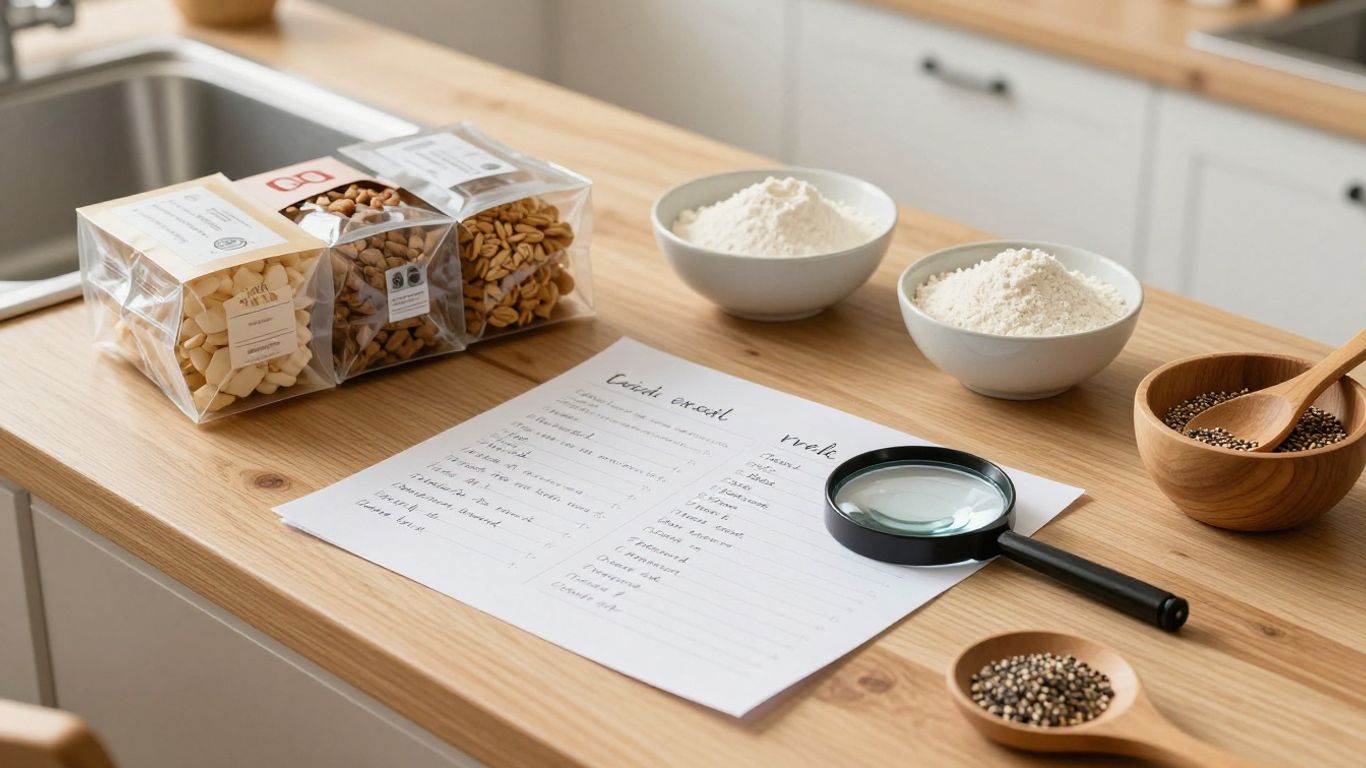
Spot milk, egg, wheat, soy, peanut, tree nut, fish, and shellfish terms
The first useful habit is to connect the everyday food with the terms likely to appear on a label. Milk may show up as whey or butter; egg may appear as albumin; wheat may be named in flour; and soy can appear in lecithin or protein. Peanuts, tree nuts, fish, and crustacean shellfish may be named directly, though a specific nut or species can be the detail that matters.
Reading becomes faster when the household’s allergens are grouped rather than memorised as one enormous alphabet soup. A person avoiding almond, for example, needs to notice almond specifically as well as broader tree-nut wording.
Recognize less obvious names such as casein, albumin, and lecithin
Technical names deserve a pause instead of an automatic skip. Casein and sodium caseinate relate to milk proteins, albumin commonly points to egg, and lecithin may be derived from soy. The source of an ingredient is what matters, so the label’s parenthetical clarification can be especially helpful.
Some ingredients have more than one possible source. When the label does not make that source clear, guessing is a poor kitchen strategy. The packet can wait while the reader checks with the manufacturer or chooses something clearer.
Watch for allergen-derived oils, flours, proteins, and flavorings
Allergens do not always arrive wearing their plainest name. They may be present as an oil, flour, protein, concentrate, extract, or flavouring, depending on the recipe. “Plant-based” also does not automatically mean free from every allergen a household avoids; soy, sesame, and nuts can all appear in foods marketed that way.
A small reference table can make this pattern easier to remember. It is not a replacement for the current label, but it gives the reader sensible places to look when a familiar food has acquired an unfamiliar name.
| Label wording or form | What the reader should consider | Useful next step |
|---|---|---|
| Whey, casein, or sodium caseinate | Possible milk source | Check the allergen statement and full label |
| Albumin or ovalbumin | Possible egg source | Look for an egg declaration or clarification |
| Lecithin or textured protein | Possible soy source | Check whether the source is named |
| Flour, starch, or malt | Possible wheat source | Read the source and any advisory wording |
This table is a prompt for closer reading, not a permission slip. If the source remains uncertain, the safest practical choice is to set the product aside until the question is answered.
Keep a personalized alias list for faster label reading
A personal list is more useful than a giant catalogue copied from the internet. It can include the allergen, its common aliases, ingredients that have caused confusion before, and the names of foods the household regularly buys. A phone note works well, provided it is updated when a clinician or manufacturer clarifies something.
The list should grow from real labels and the person’s own avoidance plan. That keeps it short enough to use and specific enough to help during an ordinary, slightly rushed supermarket trip.
Decode precautionary statements without panic or false confidence
Precautionary statements include phrases such as “may contain” and “made on shared equipment.” They usually point to possible cross-contact during manufacture, not an ingredient deliberately added to the recipe. Their wording can be frustratingly vague, but vague does not mean meaningless, and silence does not necessarily mean a product was made in a perfectly isolated bubble.
What “may contain” and “made on shared equipment” really suggest
A “may contain” warning suggests that an allergen could have entered the food unintentionally. “Made on shared equipment” points to a route by which cross-contact may occur during production. Neither phrase tells the reader exactly how much allergen might be present, so the wording cannot be used to calculate a personal level of risk.
For someone with a diagnosed food allergy, the right response to such warnings belongs in the person’s established plan. The packet’s calm-looking design does not cancel the cautionary sentence beside the ingredients.
Why precautionary wording is voluntary and inconsistent
Advisory statements are not presented as a single, perfectly consistent system across every product. Manufacturers may use different wording, and the absence of a warning is not a universal guarantee that cross-contact cannot happen. That inconsistency is one reason the ingredients list, the company’s information, and professional guidance all have a role.
The reader can sort a label’s language into practical questions rather than trying to decode its tone. A simple checklist helps keep uncertainty from turning into either panic or overconfidence:
- Is the allergen listed as an ingredient or in a “Contains” statement?
- Is there a precautionary phrase about possible cross-contact?
- Does the wording match the person’s clinician-provided action plan?
- Can the manufacturer clarify the process or current label?
Once those questions are answered, the decision is usually clearer. If uncertainty remains significant, choosing a different food is a reasonable way to make the meal less complicated.
Decide when a vague warning is a deal-breaker
A deal-breaker depends on the person’s allergy, history, and medical plan, not on how alarming the sentence looks. Some households avoid every precautionary statement for a particular allergen; others have individual guidance that shapes the decision. A general article cannot safely choose that boundary for them.
The useful rule is consistency. The household should decide its approach with its clinician and apply it calmly, rather than making a fresh judgement while hungry in the supermarket aisle.
Contact manufacturers when the label leaves you guessing
A manufacturer may be able to clarify an ingredient source, a current formulation, or the meaning of a processing warning. The reader should have the exact product name, package size, lot information if available, and the question written down before making contact. That turns “Is this safe?” into something the company can actually investigate.
A reply should be treated as information about that product at that time. Keeping the answer with the package note can help when the same question appears again, although the label still deserves a fresh check.
Handle labels that change, because recipes enjoy plot twists
A familiar packet can quietly become a new recipe wearing an old outfit. Suppliers change, factories change, and seasonal versions may follow different processes. Allergy label reading therefore works best as a habit repeated at purchase, not a memory test based on what was safe last month.
Recheck familiar products every time you shop
The same brand and nearly identical packaging do not guarantee identical ingredients. A reader should check the “Contains” line, scan the ingredients, and notice any new advisory wording each time. This takes less effort once the routine is established, especially when the scan starts in the same place.
The habit may feel excessive for a food bought every week. That is precisely why it matters: routine is when people are most likely to stop looking.
Compare the package with the manufacturer’s current ingredient list
A company website can help confirm current information, but the physical packet remains the item being purchased. Online pages may lag behind a reformulation, while a product page may cover several sizes or varieties. If the two sources disagree, the reader should contact the company or choose a clearly labelled alternative.
Screenshots and saved pages can be useful records, but they are not permanent certificates. They capture a moment in a recipe’s surprisingly eventful life.
Watch for new suppliers, seasonal editions, and reformulations
Words such as “new recipe,” “limited edition,” or a changed package design deserve a deliberate second look. Seasonal products can come from different production runs, and a supplier change can introduce an allergen that was not present before. Even a small ingredient adjustment may matter to someone with a serious allergy.
The safest approach is to treat every variation as a new product until its label has earned familiarity. Nostalgia is lovely; it is not an ingredient check.
Keep screenshots or notes of products that are reliably safe
A short list of products that have worked well can make shopping less tiring. The note should include the exact variety and, where useful, a photo of the package or current ingredient panel. It can also record questions asked and answers received.
That record is a convenience, not a substitute for checking the next packet. It helps the reader find a starting point while leaving room for recipes to change their minds.
Navigate confusing foods and packaging situations
Not every food arrives in a neat packet with a readable ingredient panel. Imported goods, bakery items, deli meals, supplements, and bulk-bin foods can create gaps in the usual routine. When information is missing, the reader does not need to be embarrassed about pausing the purchase; uncertainty is a valid reason to choose something else.
Read labels on imported foods and unfamiliar brands
Imported products may use different ingredient names, allergen conventions, or languages. An apparently familiar term may not mean exactly what the reader expects, and translation alone may not explain manufacturing warnings. A reliable translation and direct manufacturer information can help, but guessing from the picture on the packet cannot.
Unfamiliar brands deserve the same slow reading as unfamiliar recipes. The first purchase is a research trip; later purchases become easier only if the formulation stays the same.
Manage bulk bins, bakery items, deli counters, and restaurant packaging
Foods sold from shared bins or open displays may not carry a complete ingredient list, and utensils can move between products. Bakery and deli staff may also need to check supplier labels rather than relying on memory. The reader should ask about ingredients and cross-contact, then accept that a confident answer may not always be available.
Packaged food prepared in a shop can change from one day to the next. If staff cannot identify the ingredients or preparation conditions, a sealed, clearly labelled alternative is often the calmer choice.
Check supplements, protein powders, and specialty foods
Supplements and protein powders can contain milk, egg, soy, nuts, or other ingredients that are easy to overlook. Flavours, blends, and added ingredients can vary between versions. Their purpose may sound wholesome, but the label still needs the same careful treatment as a snack.
The reader should check the full ingredient panel, serving format, and any allergen statement. If the product has been recommended for a particular health reason, questions should go to a qualified clinician rather than being solved by label guesswork.
Know when a product has no ingredient label at all
Fresh produce and some foods prepared at home may not come with a formal ingredient list. That does not make them automatically safe, especially when they have been cut, seasoned, coated, or packed alongside other foods. The person buying or preparing them may need to explain what was added and how it was handled.
If the answer cannot be established, the food is not a good candidate for experimentation. A simple, known option is less exciting but much easier to manage.
Prevent cross-contact beyond the ingredient list
A food can have an acceptable recipe and still become risky through shared hands, utensils, surfaces, oil, or containers. Cross-contact is different from adding an allergen as an ingredient, but the practical result can still matter to someone with an allergy. Label reading is therefore one part of a wider kitchen routine.
Separate ingredients, utensils, and preparation surfaces at home
At home, ingredients can be stored in clearly identified areas and prepared with clean utensils and surfaces. Spreads, chopping boards, pans, and crumbs deserve attention because small leftovers can travel further than anyone expects. A household routine should be simple enough that children, visitors, and tired adults can follow it.
Cleaning and separation practices should match the person’s medical plan. The aim is not a spotless museum kitchen; it is a predictable one where the route from packet to plate is understood.
Ask precise questions when eating at restaurants
A broad question such as “Is this allergy-friendly?” may produce a broad answer. More useful questions ask what is in the dish, which sauces or garnishes are added, whether a shared fryer or grill is used, and whether the kitchen can prevent cross-contact. The diner should tell staff about the allergy clearly and allow time for an answer.
If the staff cannot give reliable information, choosing a different dish or leaving the item off the order is sensible. A charming menu description cannot inspect the kitchen.
Understand why removing an allergen after cooking may not help
Picking nuts off a dessert or scraping cheese from a finished dish does not necessarily remove all contact with the food. The allergen may have mixed into a sauce, crumb, batter, oil, or cooking surface. Once the food has been prepared together, its parts may no longer be neatly separable.
That is why prevention before cooking matters more than a rescue attempt afterwards. The person’s clinician or action plan should guide how strictly this is managed.
Build a travel and emergency routine around safer choices
Travel adds unfamiliar kitchens, changing labels, and fewer easy alternatives. A prepared routine can include known foods, translated allergy information where needed, and a plan for communicating with accommodation or restaurant staff. It should also allow extra time, because hurried decisions are rarely a food-allergy family’s favourite souvenir.
The routine should be reviewed before each trip and adapted to the destination. Familiar supplies can reduce uncertainty, but they do not remove the need to check anything bought along the way.
Turn allergy label reading into a faster daily habit
Careful label reading does not have to make every shop feel like an examination. With repetition, the reader can use the same order each time and reserve detailed investigation for products that genuinely need it. The goal is not speed at any cost; it is dependable attention with less mental clutter.
Use a three-pass scan for new products
A three-pass scan keeps the process orderly. First, check the “Contains” statement or equivalent allergen disclosure. Next, read the complete ingredient list for familiar and technical aliases. Finally, look for precautionary wording and compare the product with the household’s established plan.
This sequence prevents the front-of-pack claims from stealing the spotlight. It also creates a clear stopping point when the label does not fit the person’s needs.
Create a “safe,” “questionable,” and “avoid” system
A simple household system can reduce repeated debates. Products with clear ingredients and a known history can go in the “safe” group; products needing a manufacturer answer belong in “questionable”; and products containing a relevant allergen or conflicting warning go in “avoid.” The labels are household categories, not universal medical definitions.
The system works best when everyone understands that “questionable” means pause, not sample. Notes can explain why an item sits there, which makes future shopping less dependent on one person’s memory.
Teach children to read labels without relying on package colors
Children can learn to look for the same few places on every packet: the ingredient list, the allergen statement, and warning language. They should know that a colour, cartoon, or familiar logo does not prove a food is suitable. Practice can happen at home with empty packets, where there is no pressure to make a quick decision.
Adults still carry the responsibility for checking and supervising. The child’s role grows with age and understanding, but a bright wrapper never becomes a reliable safety system.
Carry an epinephrine auto-injector and follow your clinician’s action plan
People who have been prescribed an epinephrine auto-injector should carry it as directed and know their clinician-provided action plan. Family members, carers, and regular school or workplace contacts should understand the plan as well. Label reading helps prevent exposure, while an emergency plan prepares the household for what to do if a reaction occurs.
The plan should be checked periodically for practical details, including device instructions and expiry information. When a reaction is suspected, the person should follow their prescribed emergency guidance and seek urgent help as directed.